
Here at Petrenko Multiphysics LLC, we believe in the importance of experimentation and professionalism. Experimentation will help a business thrive, while professionalism will set it up for global standards. These two qualities have always been some of the major parts of our company. Instead of offering basic deicing services for all of our clients, we’ve decided to take it up a notch. Since many clients still don’t have full awareness regarding deicing or defrosting processes, we opened up consultation services. Through consultations, clients will learn more about the intricate process of deicing. We often share information about chemical processes, equipment used, skills needed, advantages of the service, limitations, and long-term benefits. The consultation is also a good way of assessing prices.
New Age Deicing Tech
Are you looking for a Powerline de-icing technology? If yes, then you can benefit from the services offered by Petrenko Multiphysics LLC!
Aerospace, Buildings, Bridge, Transportation
Aerospace, Buildings, Icemakers
Transmission and distribution power lines
Transmission and distribution power lines
Refrigeration, Liquefied Gas production
Aerospace, Buildings, Bridge, Cars
Aerospace, Buildings, Bridge, Cars
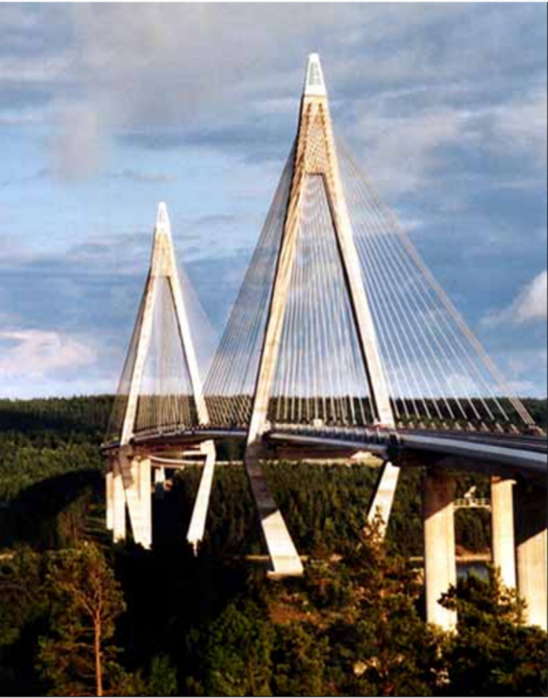
Uddevalla-bridge. General view of the Uddevalla-bridge in Sweden. PETD has been installed and tested on several cables and one pylon-top during the 2004–2005 and 2005–2006 winters.
Pulse Electro Thermal Deicing
De-icing is a process in which interfacial ice attached to an engineering structure is either broken or melted. Some sort of external force (gravity, wind-drag) then removes the ice from the surface of the structure. Mechanical deicers take less energy, but they don’t clean structures well leaving significant amounts of ice. They also may damage structures and accelerate ware. Thermal de-icing does the job well, but it takes too much electric (or other) energy. We have invented, developed and tested a new de-icing method, which significantly (sometimes in one hundred times) reduces the energy needed for deicing. In doing so, we mimic “an ideal” thermal deicer that takes an absolute minimum amount of energy. The ideal deicer should melt only a very thin layer of interfacial ice, leaving the temperature of the environment unchanged. But because in conventional deicers a heater is thermally connected to ice, to a protected structure, and to outside environment, large heat losses are inevitable. In a typical deicer the losses exceed by orders of magnitude the amount of “useful” heat that is used to melt interfacial ice.
A pulse deicer cuts these heat-drainage mechanisms by heating only a very thing interfacial layer during a very short pulse of 10 ms to 10 s long. Because of the short heating time, the heat does not propagate in the environment. Instead, it warms only an interfacial layer of ice increasing its temperature just above the ice melting point. The ice then slides off on the liquid film. The pulse deicer was successfully tested for de-icing airplanes, car windshields, bridge over-structures, metal walls, metal cables, glass roofs, etc. The deicer demonstrated almost instant action in combination with saving up to 99% of electric energy in comparison with conventional heaters.
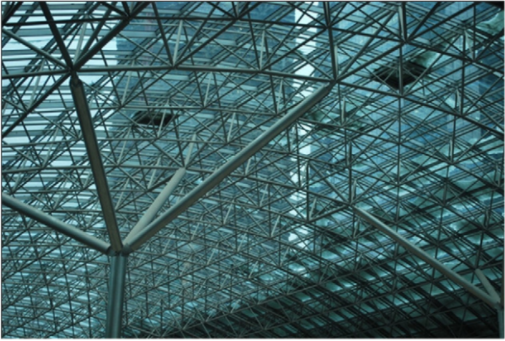
Moscow Atrium. View of the glass dome-shaped roof of the Moscow Atrium, Moscow-City, Russia. Total area of the roof is approximately 10,000 m2.
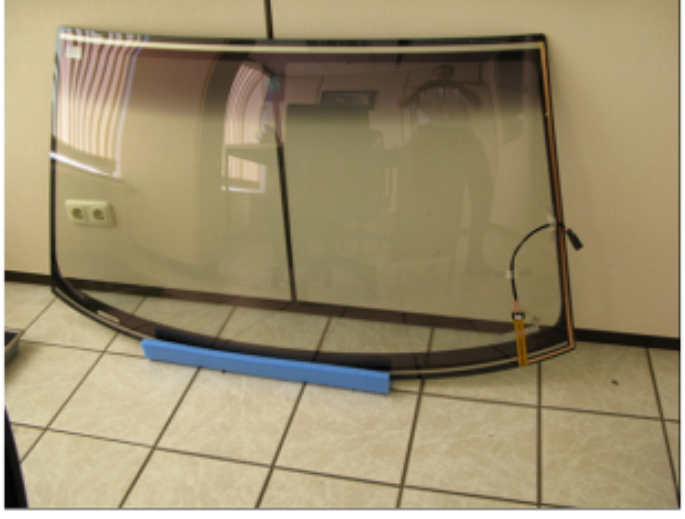
An automotive windshield equipped with a PETD. The heated area of glass between the copper bus-bars is very close to 1.0 m2.
Variable Resistance Conductors
DEICING OF POWER LINES WITH NO POWER INTERRUPTION
To minimize power loss in transmission lines, their conductors are designed to be “cold”. While saving energy, this makes the conductors prone to icing and may result in break of the line conductors and possibly even collapse of the line towers. We invented and tested transmission/distribution line conductors which stay cold in normal power transmission operations, but switch to a hot-mode to either remove accumulated ice or to prevent ice formation. The technology is applicable to bundle conductors which have three or more conductors per phase (n ≥ 3). The switching from the normal power-transmission mode to the deicing power-transmission mode is performed by reconnecting the conductors in a bundle from parallel to series connections. The reconnection is done by a few small low-voltage solid state switches that are integrated into the conductor. When a line has only one conductor per phase we can do similar deicing job using
high-frequency VRC.

Variable-resistance conductor system using three parallel strands of conductor,represented by resistors. With the switches all off the resistance from the left terminalto the right terminal is 32=9 times the resistance when the switches are on and all the conductors are connected in parallel.
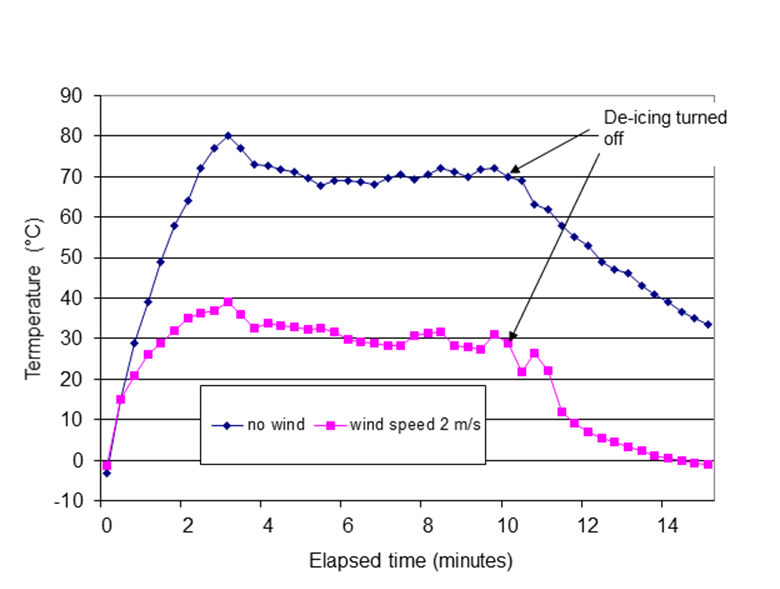
Laboratory test results of cable temperature vs. time. The cable temperature rises quickly and then levels off when automatic temperature control engages, and finally drops off when de-icing is turned off.

Heat-Storage De-Icing
This deicing technology is very similar in its physics to the Pulse Electro-Thermal Deicing (PETD). It also almost instantly melts a very thin layer of interfacial ice and ice then slides off from a surface (roof, building, refrigeration evaporator, icemaker etc.). The difference is that to melt the ice/structure interface the thermal energy is slowly accumulated in a heat storage and then rapidly delivered to the ice/structure interface. Either a low-power power supply (such as a solar panel) or waste heat is used as a source of the thermal energy. Compared to PETD, HSD takes either low-power or zero-power energy sources. Some examples are heat rejected in refrigerator condensers, solar energy and geothermal heat.
Pulse Electrothermal Brake: No Slipping On Ice And/Or Snow
Melting a very thin layer of ice or snow may not only deice or defrost a surface of an engineering structure, but it can instantly bond a surface (of a tire, a shoe, a ski) to ice and snow. It happens when a liquid layer is instantly frozen in contact with a cold surface. By varying the heating pulse energy and duration we can rapidly freeze a surface to ice. The technology has been successfully tested on automotive tires, shoes and cross-country skis.